DJ merch: how to order your first 25 shirts
The complete guide to your first merch run: choosing a print method, supplying your artwork, splitting sizes, ordering. With concrete prices and delivery times.
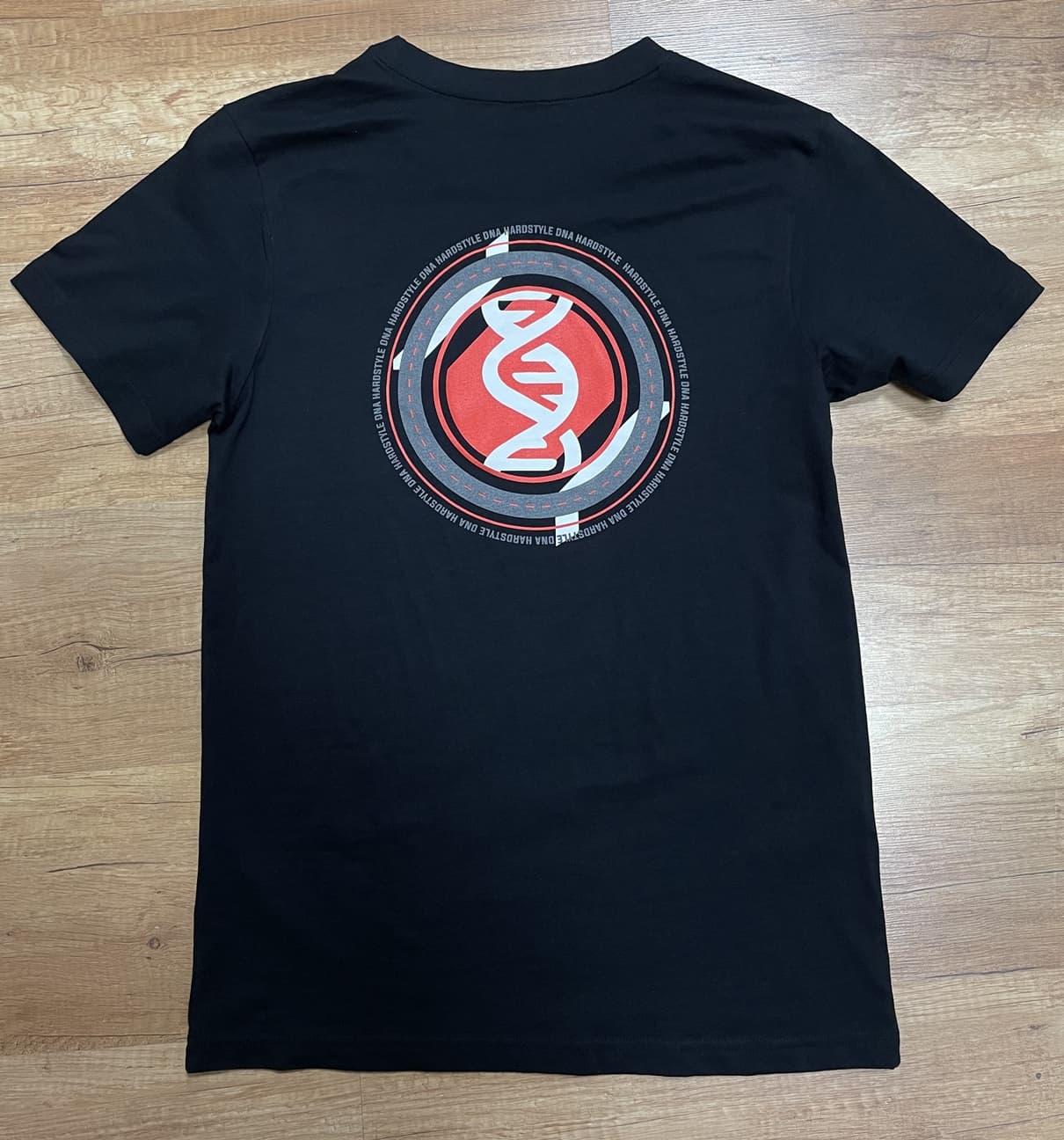
Most up-and-coming DJs don't doubt whether they want merchandise, but how much. A friend says a hundred pieces per shirt is much cheaper. The print shop says fifty is the sweet spot. Your own stock-anxiety says twenty-five already feels like enough risk.
Why 25 pieces is a sensible starting point
Twenty-five pieces isn't about optimising unit price, it's a learning round. You find out which sizes your audience orders, which colour and shirt model sell best, and how your drop logistics work, from your very first set.
With that data you can scale your second run on facts instead of assumptions. For less than a hundred euros extra compared with a fifty-piece run, you have a far smaller chance of a box of unsold stock.
Step 1: the right print method
For twenty-five pieces on a dark shirt, DTF is the logical print method. Below fifty pieces, the setup costs of screen printing are too high per shirt to be competitive, and at five to seven working days the delivery time is about a week shorter than screen printing.
If you're working with light shirts or a simple colour palette, you can consider screen printing, but at twenty-five pieces DTF stays cheaper in almost every case. If you want to understand the difference in detail, read our DTF vs screen printing guide.
Step 2: supplying your artwork properly
Supplying your artwork is where a lot of beginners lose time unnecessarily. You need a PNG or PDF on a transparent background, at a minimum of 300 DPI at the intended print size.
A logo you want to print thirty centimetres wide therefore needs to be at least 3540 pixels wide. A screenshot from Canva at 1080 by 1080 pixels isn't a suitable file for textile print. It comes out blurry and can't be repaired in the production stage.
No vector? No problem. A good PNG at print resolution is enough for a single run. If you want to use the same logo more often in different sizes, it pays to have your design vectorised once.
Step 3: splitting sizes
For a DJ audience with a mixed age range, for twenty-five pieces we recommend the following size split: three times S, seven times M, nine times L, five times XL and one time XXL.
This split works for most crowds at EDM, hardstyle and techno sets. For a specific audience, adjusting pays off. A female audience at R&B and house orders S and M more often, a hardcore and uptempo crowd more often L and XL, and a festival crowd with crew merch also needs XXL and XXXL.
Step 4: ordering through the design tool
The ordering itself happens through our online design tool. You go through the order step by step: shirt choice in model, colour and material; uploading your design; setting the placement; filling in sizes and quantities; confirming the print method.
At the end you see the total price. For twenty-five DTF shirts on a Build Your Brand black heavy oversize, the unit price typically sits between eleven and fourteen euros, including VAT and excluding shipping.
With us you automatically get five percent volume discount from ten pieces, ten percent from fifty pieces and fifteen percent from a hundred pieces. That discount is already worked into the final price you see in the design tool.
Step 5: planning delivery and sales
Five to seven working days after ordering, it's at your home or the delivery address you gave. The timing of your drop matters more than many beginners think.
Plan your merch launch around an upcoming set so your audience can buy at a moment when they're in the mood. A drop without context, just the announcement that the shirts are now here, works considerably less well than a drop around a set, release or festival.
In practical terms, at the point of sale always bring cash and a payment QR code (Tikkie or payconiq), lay out all the sizes so people can buy what they see in front of them, and ask buyers for their email or Instagram handle. That last one is your marketing list for your second run.
How Serzo handled his first run
For his first run, Serzo chose fifty t-shirts in black with a single-colour bright design. No complex colour nuances, no photo, sharp lines, suitable for both DTF and screen printing. At fifty pieces DTF was slightly cheaper and faster.
He sold out in six weeks through a mix of sales at shows and orders via Instagram stories. The lesson from his second run was that hoodies sell better after shows in the colder months than t-shirts, and in summer that balance flips.
An open door, but a lot of DJs only order their winter merch in December, a few weeks too late for the peak of shows.
Common mistakes
A size split that's too broad with few pieces per size (one XS, two S, three M, four L, three XL, two XXL) sounds balanced, but you won't sell the XS and your M runs out after five people.
A design that's too complex for a first run, like a photo collage with five colours, rarely works as well as a recognisable logo with one to three colours.
No pre-launch communication means your merchandise has to sell itself, which it doesn't; start announcing at least a week before the drop.
And collecting no customer contact is shooting yourself in the foot, because who your first buyers are is valuable data for future runs.
Getting started
Open the design tool, pick a shirt, upload your design and set your run size. Five to seven working days later they're ready for your first show.